Home Dataset Research Capabilities Early Access

Building AI Infrastructure for

MATERIALS

Building open datasets, foundation models, and scientific AI infrastructure
to accelerate the discovery of next-generation materials for batteries,
semiconductors, energy storage, and beyond.

Explore Research

ABOUT US

Scandium Labs is an AI for Science research company building open infrastructure for computational materials discovery. We develop high-quality materials datasets, foundation models, and machine learning systems that help researchers explore millions of candidate materials before expensive laboratory or DFT validation. Our mission is to make materials discovery faster, reproducible, and accessible.

THE PROBLEM

Today's materials discovery is too slow. Each DFT calculation takes hours to days. Experimental validation takes weeks to months. Millions of candidate materials remain unexplored because the computational and experimental cost of screening them is prohibitive.

OUR APPROACH

Curate high-quality materials data from multiple sources. Train physics-aware foundation models. Screen millions of candidates in minutes. Prioritize only the most promising materials for expensive simulation and laboratory validation.

I.
0
MATERIALS IN DATASET
II.
0
INTEGRATED DATABASES
III.
0
MODEL IN PRODUCTION
IV.
0
RESEARCH PAPER PRE-PRINTS
SOON TO BE PUBLISHED

OPEN DATASET

Scandium Dataset v1.0

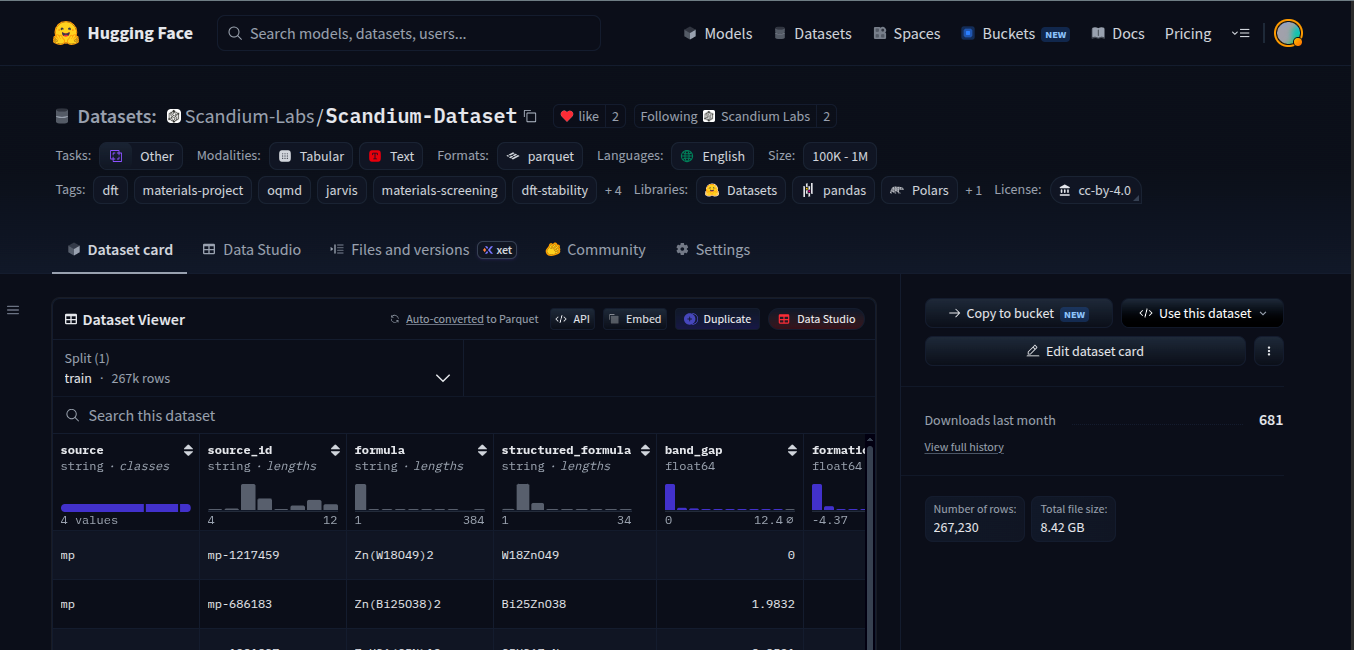
A harmonized, quality-scored dataset combining Materials Project, OQMD, and JARVIS — designed for AI-driven materials discovery. 267,230 materials with standardized properties, cross-source provenance, and rigorous validation.

COVERAGE

267,230

Unique material entries from 3 major databases

PROPERTIES

9+ Labeled Properties

Formation energy, band gap, energy above hull, density, volume, space group, crystal system, magnetic ordering, and more

LICENSE

CC BY 4.0

Openly available for research and commercial use with attribution

View Full Dataset Page View on Hugging Face
Open Materials Dataset Foundation Models Battery Discovery Scientific AI Materials Informatics Computational Materials

WHAT WE BUILD

Our Work

From open materials datasets to physics-aware foundation models, we build the infrastructure that enables researchers to accelerate materials discovery with AI.

Scandium Dataset
×

A harmonized dataset combining Materials Project, OQMD, and JARVIS with quality scores, provenance tracking, and standardized material properties for AI-driven materials research.

  • I.267,230 materials from 3 databases
  • II.Quality-scored and validated
  • III.Cross-source provenance tracking
  • IV.CC BY 4.0 open license
Foundation Models
+

Physics-aware graph neural networks trained on large-scale crystal datasets for transferable materials property prediction across diverse material families.

  • I.Physics-informed modeling
  • II.Multi-property prediction
  • III.Transferable across families
  • IV.Benchmarked against state-of-the-art
Battery Materials Discovery
+

Accelerating screening of solid electrolytes, cathodes, and anodes through AI-guided discovery pipelines purpose-built for solid-state battery materials.

  • I.Solid electrolyte screening
  • II.Cathode discovery
  • III.Ionic conductivity prediction
  • IV.Stability against lithium metal
</>
Research Infrastructure
+

Open datasets, reproducible benchmarks, and developer tools that make AI-driven materials research accessible to the global scientific community.

  • I.Open datasets on Hugging Face
  • II.Reproducible benchmarks
  • III.Model cards and documentation
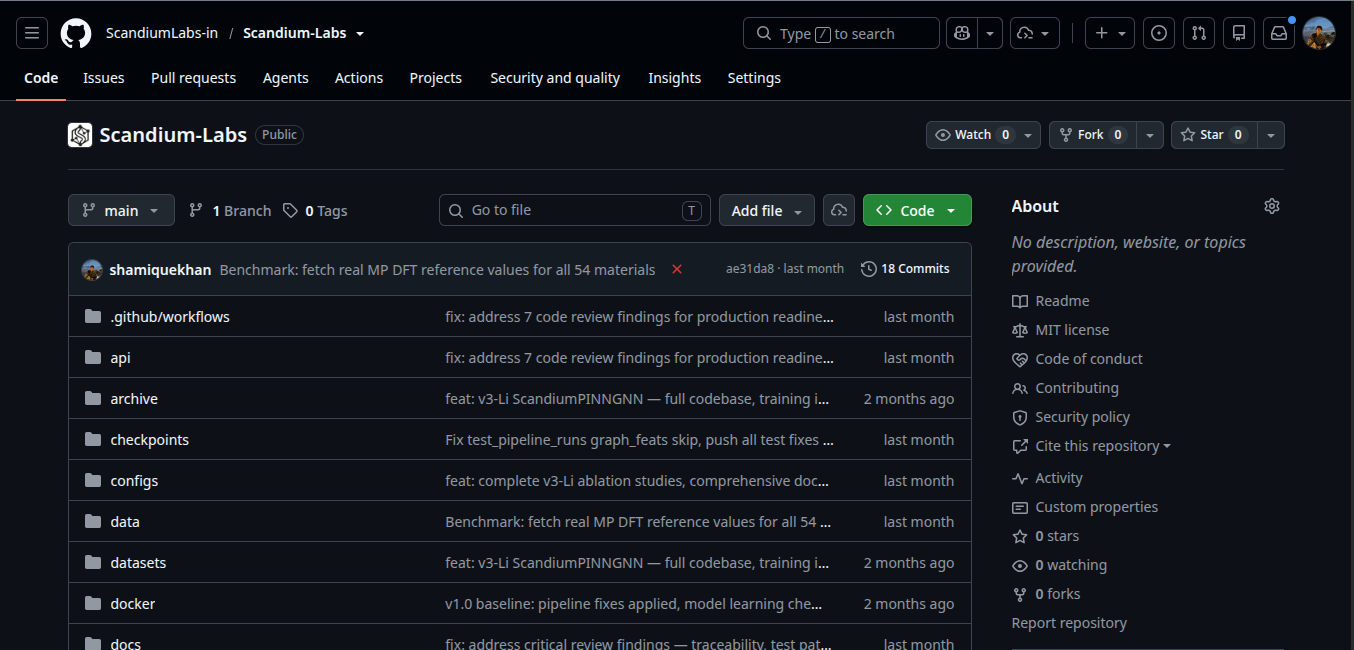
  • IV.GitHub open-source tools
Scandium Dataset SCANDIUM DATASET

OUR RESEARCH

Published Work

Our research forms the scientific foundation of the Scandium Labs platform. Every dataset and model is built on rigorous validation, cross-source verification, and reproducible pipelines.

Foundation Model 2025

ARCHITECTURE

Physics-Informed Crystal Prediction

A research line focused on improving generalization and physical consistency through constrained message passing for crystal property prediction.

Research Program · 2025

Scandium Dataset 2025

DATASET

Scandium Dataset v1.0

A harmonized, quality-scored dataset of 267,230 materials from MP, OQMD, and JARVIS with provenance tracking and standardized properties for AI-driven discovery.

Released · CC BY 4.0

Battery Benchmark 2025

BENCHMARK

Battery Materials Benchmark

Standardized evaluation of AI models on solid-state battery electrolyte discovery, with reproducible splits, metrics, and baselines.

In Development

PUBLICATIONS & RELEASES

Our Output

I. Physics-Informed Crystal Prediction — Research Program
RESEARCH PROGRAM 2025
II. Scandium Dataset v1.0 — 267,230 curated materials
HUGGING FACE 2025
III. Scandium Labs GitHub — Open-source tools and benchmarks
OPEN SOURCE 2025
IV. Scandium Benchmark — Standardized evaluation suite
BENCHMARK 2025
V. Model Cards — Transparent documentation for every model
DOCUMENTATION 2025
VI. SSB Foundation Models — Solid-state battery AI roadmap
ROADMAP 2025

FOUNDER

Building the Future of
AI for Materials Science

Scandium Labs was founded with a simple belief: the next breakthrough in energy, computing, and sustainable technologies will begin with better materials. By combining machine learning, computational materials science, and open scientific infrastructure, we aim to accelerate how researchers discover and evaluate new materials.

Shamique Khan

Shamique Khan

Founder & AI Researcher

Computer Science undergraduate specializing in AI and ML. Focused on graph neural networks, scientific machine learning, and computational materials discovery for solid-state batteries.

LinkedIn GitHub ResearchGate
"I started Scandium Labs because materials discovery shouldn't be limited by computational cost or fragmented data. Our goal is to build open AI infrastructure that helps researchers discover the next generation of materials faster."

RESEARCH

Physics-Informed Graph Neural Networks

OPEN DATA

Scandium Dataset · 267,000+ materials

AI MODELS

Foundation Models for Materials Science

APPLICATIONS

Solid-State Battery Discovery

COLLABORATE

Interested in collaborating?

Scandium Labs welcomes researchers, students, and industry partners who share our vision for accelerating materials discovery through AI.

Collaborate With Us

EARLY ACCESS

Access the Future of
Battery Materials Discovery

Scandium Labs is providing limited early access to its Solid-State Battery Dataset and Foundation Models for researchers and industry partners working on computational materials science.

RESEARCH ACCESS

For academic researchers, universities, and open-source contributors.

  • Early access to the SSB Dataset
  • Dataset documentation and metadata
  • Benchmark datasets and evaluation tools
  • Research updates and release notes
  • Community Discord / Slack (coming soon)
  • Priority access to new dataset releases
Request Research Access →
INVITATION ONLY

INDUSTRY PREVIEW

For battery manufacturers, energy companies, and industrial R&D teams.

  • Access to preview SSB Foundation Models
  • Private evaluation program
  • Technical discussions with research team
  • Early API access (when available)
  • Research collaboration opportunities
  • Feature requests and feedback
Apply for Industry Access →

Currently in Early Research Preview. Access is granted based on research relevance, collaboration opportunities, and available capacity.

COMMUNITY

Open Science in Action

Our work is built in the open. Follow our progress across platforms and join the community.

700+

Dataset Downloads

2M+

Model Trained On

2.5K

LinkedIn Followers

3

Research Platforms

GET IN TOUCH

Start a Conversation

Whether you want to discuss a research collaboration, dataset feedback, industry partnership, academic collaboration, or open-source contribution — we'd love to hear from you.

PHONE

+91 98765 43210

LOCATION

IIT Research Ecosystem
India

OUR VISION

We believe the future of scientific discovery will be accelerated by open data, reproducible machine learning, and collaborative research. Scandium Labs is building the infrastructure that enables researchers worldwide to discover the next generation of materials faster than ever before.